

This paper is a personal experience that I am presenting with actual facts of my visit to the Masroor Rock-cut Temple. All this is what I personally observed and visited during the trip. The blog includes all the significant details of Masroor Temple such as its history, architecture, location, facts that must be known, photo views, travel routes, best time to visit, entry process, on-site facilities, budget tips, and a recommended half-day itinerary.
I have also provided comparisons to other rock-cut temples, commonly posed questions to first-time visitors, and professional opinions to enable you to appreciate the significance of this heritage site better. I have also included my personal experience of the journey like the route of the trip, buying the entry ticket, the area of the lake, security, the seating area, QR code history boards, and the general ambiance of the place so that the readers have a clear and honest picture of what to expect.
This guide is composed in a way that it can assist travelers, beginners and families to plan their visit without any hassle and also to understand why Masroor is one of the hidden heritage gems of Himachal Pradesh.
Table of Contents
Introduction to Masroor Rock-cut Temple
Why Masroor Temple Is One of Himachal’s Hidden Heritage Gems
Masroor Temple is a secret jewel in Kangra valley. This group of temples was carved out of a single sandstone hill around the 8th century and is now sitting peacefully on a hilltop with the Dhauladhar mountains in the background. Masroor is not located on the primary tourist route, and thus, is not noticed by many visitors. It is a gem of a Himalayan heritage that is yet to be discovered with its ancient carvings and serene environment.
What You’ll Learn in This Guide (History, Architecture, Photos, Budget & Personal Tips)
- History: History, myths, and chronology of the temple.
- Architecture: The way the temples were sculpted, their design and structure.
- Photo Gallery: Temple description and landscape.
- Traveling Advice: Roads, seasons, access regulations, and infrastructure.
- Budget & Itinerary: Sample costs, local hotels, and half-day plan.
- Personal Experience: Impressions and tips on first hand visit.
Masroor Rock-cut Temple Explained
What Is the Masroor Rock-cut Temple?
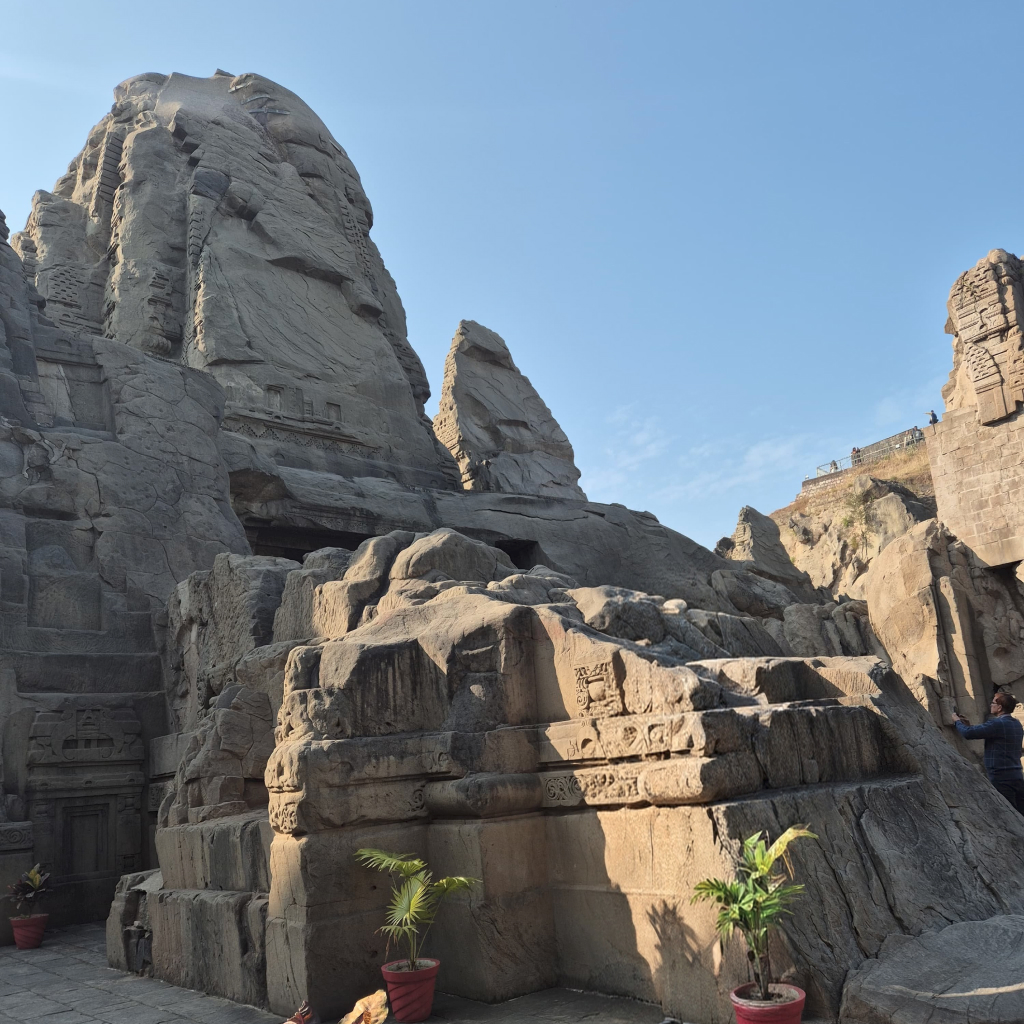
Masroor (or Masrur) is a cluster of early-medieval Hindu temples hewn out of a single huge hill of red sandstone. The location has approximately 15 shrines, each having its tower (shikhara), which are connected to each other as a single monolithic building. It appears to be a small temple city carved out of rock, as seen above. The main shrine (known as the Thakurdwara) now contains statues of Rama, Lakshmana and Sita. But original carvings of Shiva, Vishnu and other gods indicate that it was dedicated to the Hindu gods at the time of its construction.

Where Is Masroor Temple Located in Himachal Pradesh?
Masroor is in Kangra district, adjacent to the village of Masroor (Nagrota Surian), Himachal Pradesh. It is located on a hill of approximately 2,500 ft above the valley of the Beas River. The temple is approximately 40 km southwest of Dharamshala and 36 km west of Kangra town. The visitors have a clear view of the snow-capped Dhauladhar range to the northeast, which is seen clearly in the hilltop. The area surrounding the temple is a forested area that has pine and deodar trees making it a very lush and calm environment.
Why This Rock-cut Temple Is Historically Important
Masroor is important because it is a rare specimen of the Himalayan rock-cut temple architecture. It is believed to have been created in the 8th century AD (late Gupta or post-Gupta period), demonstrating the extent to which the art of temples was spread even to the most distant mountainous areas. The grand design and carvings that still remain (gods, goddesses and epic legends) provide a glimpse of Hindu religious art at the time. Although it was destroyed by earthquakes in some areas, what is left at Masroor is a treasure trove of the Indian ancient heritage. It is historically unique as archaeologists consider it to be the only large complex of rock-cut temples in North India.
5 Must-Know Facts About Masroor Rock-cut Temple
Fact 1: The Entire Complex Is Carved from a Single Rock
The 15 temples of Masroor were hewn out of one block of sandstone. The structures were cut downwards with builders first cutting trenches around a large rock to isolate it. They carved the interior rooms and the high spires out of a single mass of stone in effect. The complex resembles a mountain with numerous shrines and peaks carved out of it. This monolithic (one-stone) method is very uncommon.
Fact 2: Himalayan Nagara Architectural Style (Rare in North India)
Masroor is built in Nagara style of temples (characteristic of North India). It has a curving spire (shikhara) in its main shrine and several smaller spires surrounding it. This is equivalent to the traditional Nagara. This great style is not common in the Himalayas, and Masroor is a unique sample of full-fledged Nagara temples hewn out of the mountains. This tradition can also be traced in the decorative carvings on its pillars and towers (floral motifs, figures of gods and epic scenes).
Fact 3: Earthquake Damage Revealed Lost Structures
The huge Kangra earthquake of 1905 shook Masroor. Certain walls and towers of temples collapsed or fell down, revealing inner chambers and carvings that had been concealed. As an illustration, one of the intended entrances was not completed, most likely due to debris. In brief, the quake not only revealed the hidden sections of the temple, but also left traces of destruction. Visitors can still today see fallen stones and missing portions which give an indication of the size of the temple in its original state.
Fact 4: Sacred Water Tank Reflects the Dhauladhar Range
Before the main temple block, there is a big rectangular water tank (kund) where they are purified. The water being calm, it serves as a mirror: the spires of the temple, and the white mountains of the Dhauladhar range, are seen in the pool. This reflection was not accidental: the serene water and the reflective landscape provide a spiritual quality. Initial temple regulations required a pool or tank and here it perfectly outlines the temples with the Himalayan landscape behind.
Fact 5: Why It’s Called the “Ellora of Himachal Pradesh”
Masroor is commonly referred to as the Ellora of the Himalayas due to the fact that it was hewn out of a single rock and is highly decorated as well as the renowned Kailasa temple at Ellora. But Ellora (in Maharashtra) is much larger (34 caves in 5th-8th centuries) and contains Buddhist, Hindu, and Jain temples. Masroor is smaller and purely Hindu. The nickname merely points out that this distant mountain location is no less bold in its idea of a monolithic temple, though on a smaller scale.
Masroor Rock-cut Temple Photos and Gallery
Temple Complex and Surrounding Landscape
The temples can be seen as a small group of red-rock shrines on a hill, a distance away. The towers of every temple are stretched up to the sky, and the snow-capped Dhauladhar mountains are stretched behind them. The bottom of the hill is covered with lush pine forests and terraced fields that are mixed with the stone architecture. The panorama is stunning and almost photographic as a whole – the temples appear to blend with the mountains in the background.
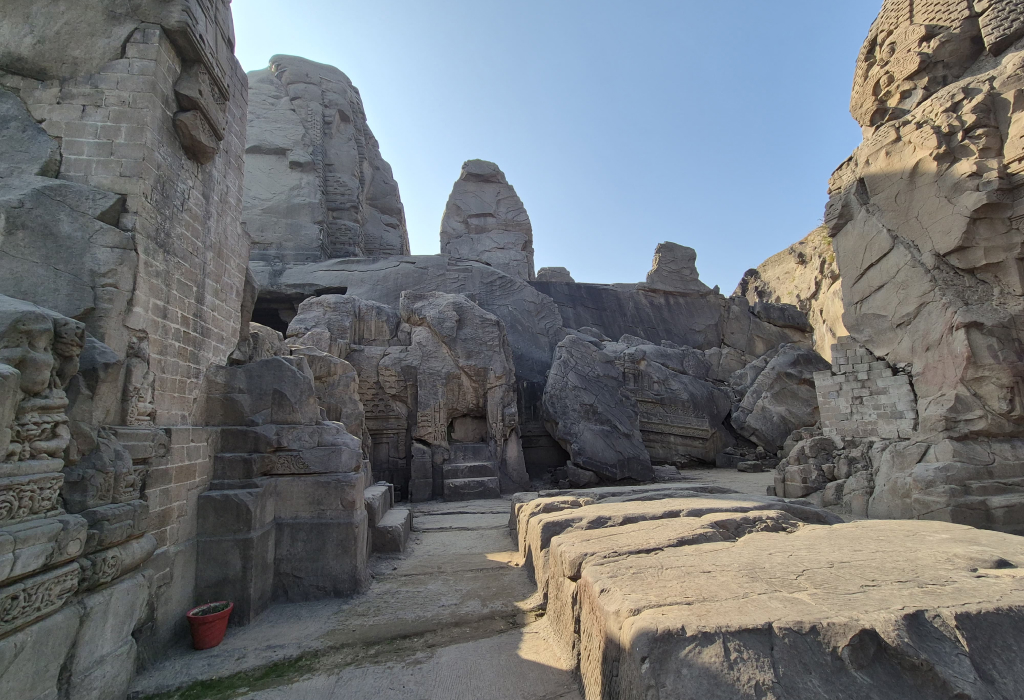 masroor temple rock cut complex panorama
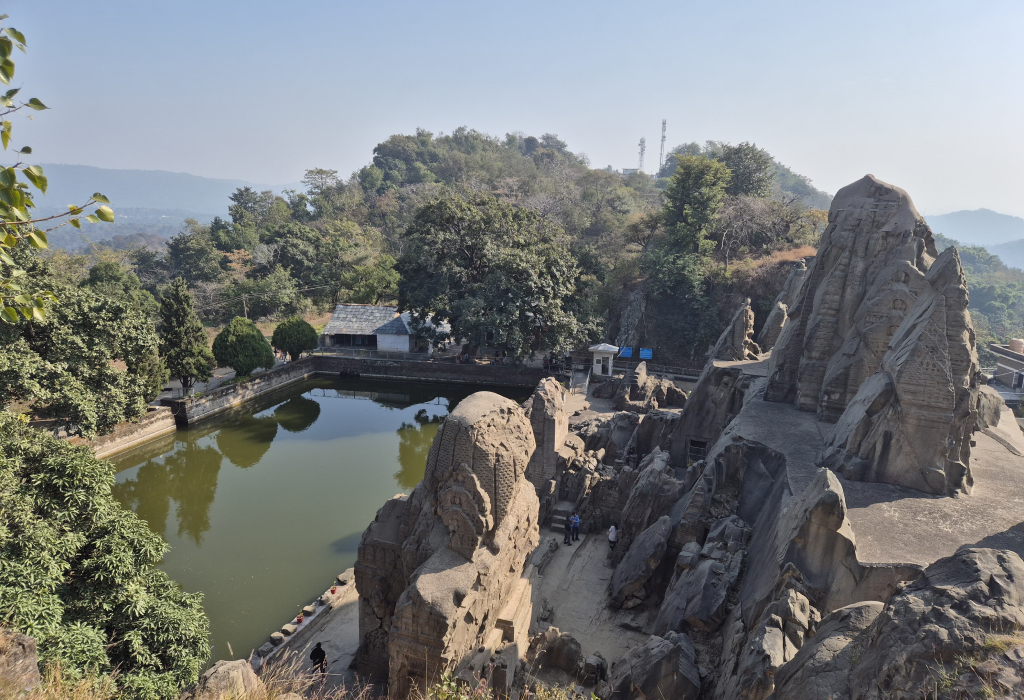 masroor temple rock carved shrine closeup
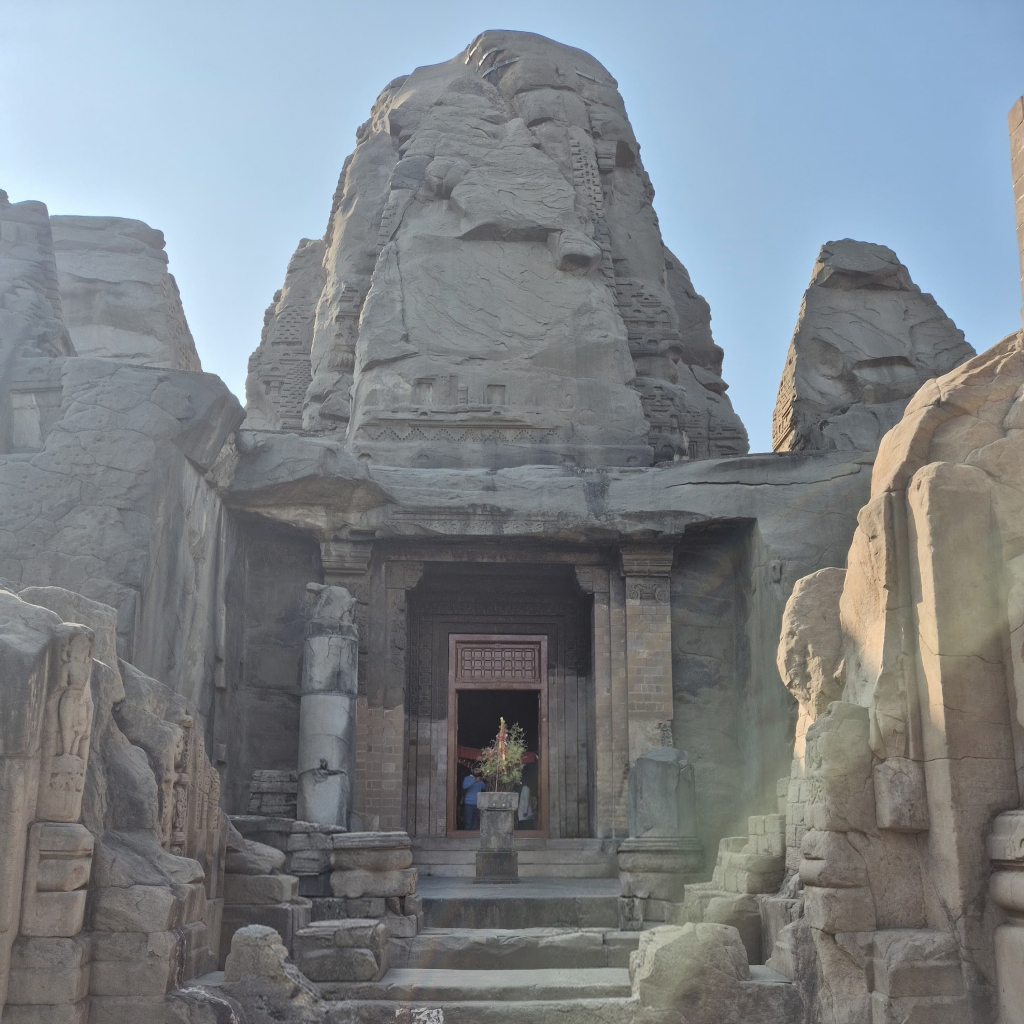 masroor temple main gate entrance view
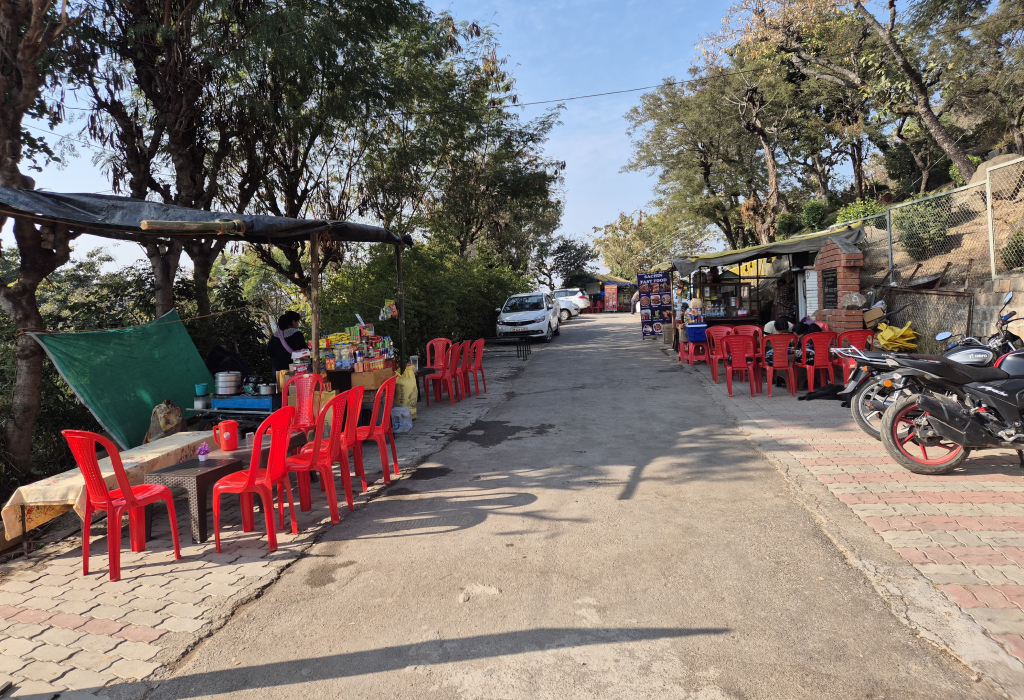 masroor temple food stalls near parking
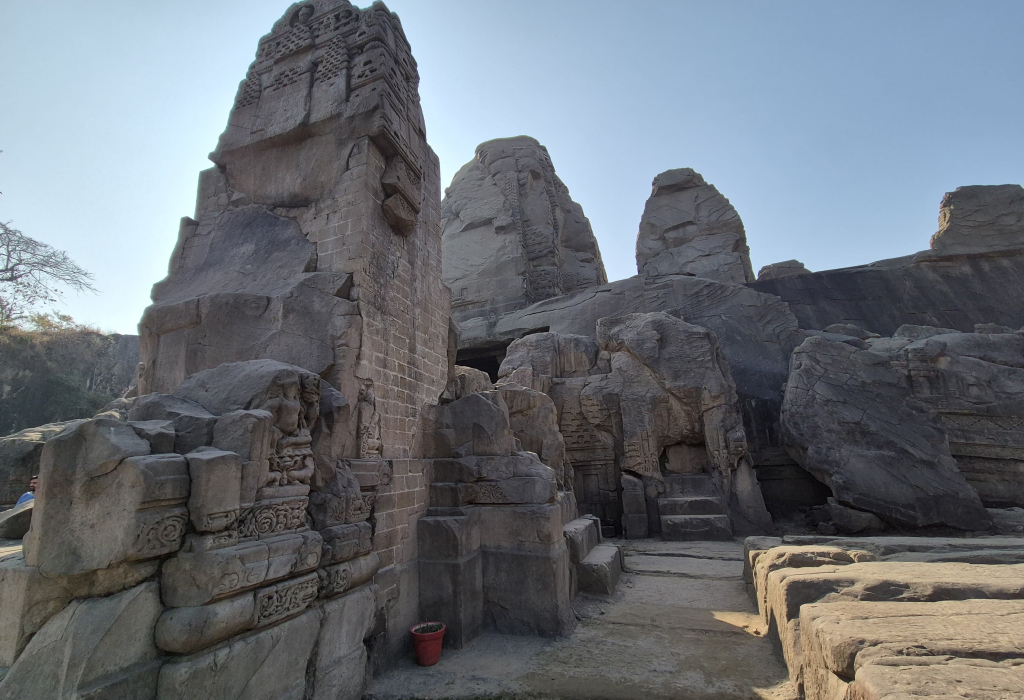 temple side view kangra valley himachal pradesh
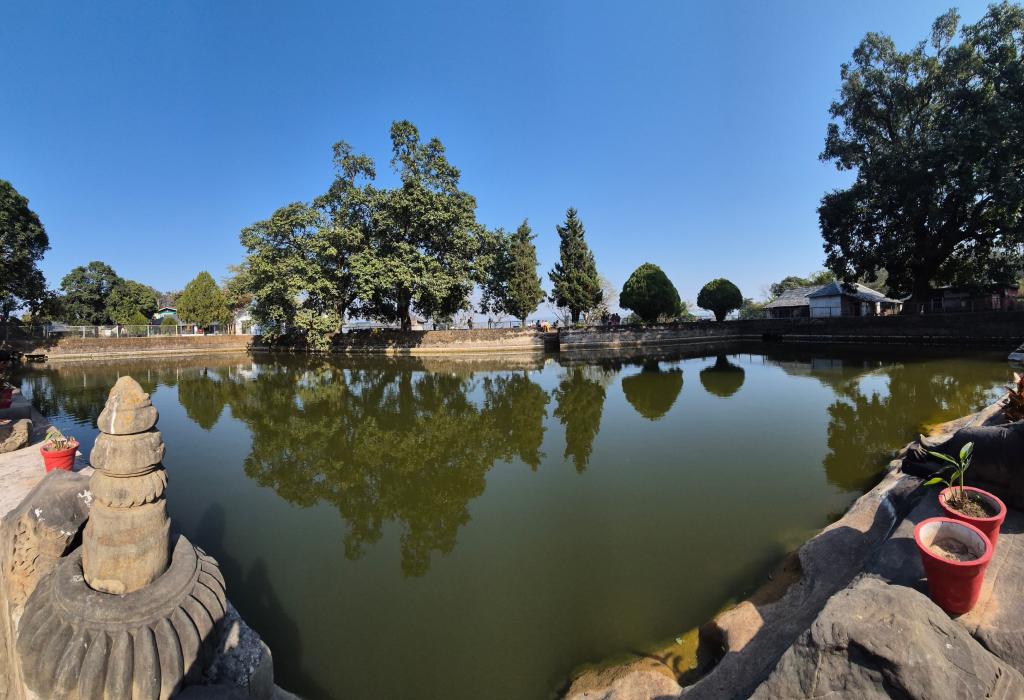 masroor rock cut temple sacred water lake
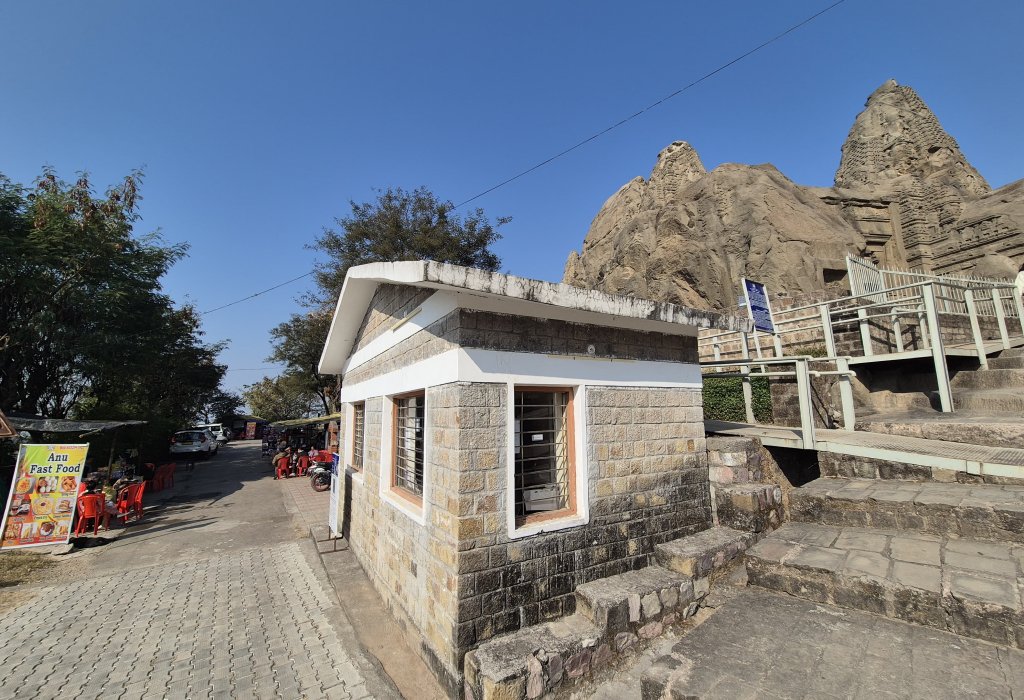 masroor rock cut temple main shrine
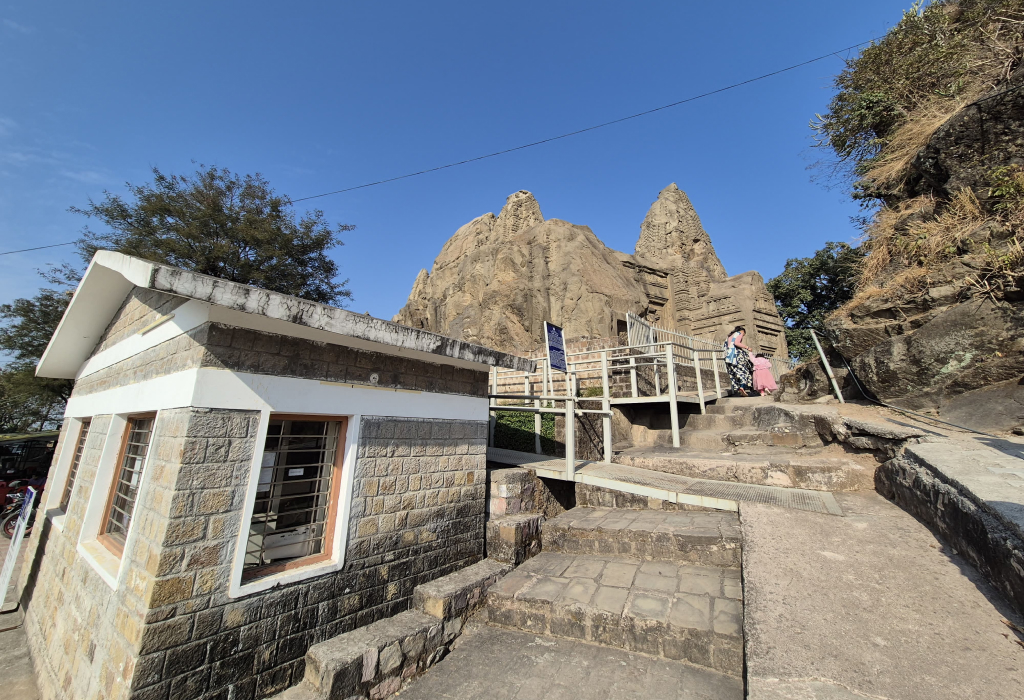 masroor rock cut temple main gate wide
 masroor rock cut temple main entrance wide kangra
My First Visit to Masroor Rock-cut Temple
We began our trip to the Rock-cut Temple at Chandigarh by car and we passed through Una and Amb Dehra. On entering the entrance, we were met with a check post where we were required to pay an online payment of 30 rupees to enter. Once inside, we observed a small lake that had fish in it and this made the environment very quiet.
There were security guards who checked our entry tickets. Within the campus, it has the main temple and stone benches where visitors can sit, relax and take pictures. QR code readers are located in various locations.
When you scan them you can easily read about the history of the temple as offered by the government. I have also included images in this article- with the help of these, you can scan the QR code or open the PDF to know more about the temple. All in all, it was a very peaceful and nice experience and we truly enjoyed visiting this beautiful place.
Origins and Complete History of Masroor Temple
When Was the Rock Temple Built? (Dating Controversies)
Masroor is dated by most scholars to the 8th century AD (the late Gupta or post-Gupta period). This suits its iconography and style of carving. No inscriptions provide a precise date, and thus it is estimated by art-historical analysis. There have been arguments of earlier or later dates, but the consensus is 7th–8th century. In this way the temples must have been carved over 1,200 years ago.
Who Built the Masroor Rock Cut Temple? (Historical Theories)
The architects of Masroor are anonymous. Local Himalayan rulers or Kangra Valley patrons commissioned it probably in the 8th century. It is proposed by historians that it was organized by regional chieftains, possibly with cultural ties to the Gupta or Gurjara-Pratihara dynasties. Anyhow, there is no record of the name of the particular king or artisan guild. The founder of the temple is therefore unknown, except as a monumental project of a kingdom in the Himalayas.
Timeline of Key Events, Discoveries, and Archaeological Studies
- c. 8th century: Sculpture of the temple complex (estimated by architectural style). It must have been used as a worshiping place at some time.
- 1905: The great Kangra earthquake (magnitude of about 7.8) occurs. Sections of Masroor walls and spires fall and uncover concealed rooms and carvings. The temple is not completely destroyed but shaken.
- 1913: It is brought to wider attention when a British officer Henry Shuttleworth visits and records Masroor.
- 1914-1916: Masroor is surveyed by Archaeological Survey of India (ASI). The colonial government declares the site a protected ancient monument. A few of the fragments that have been lost are taken to a museum in Shimla.
- Mid 20th century: Simple conservation by ASI (propping walls, clearing debris). Masroor is not famous but it is a historic site.
- 2000s-Present: Tourism grows in a modest way. Roads are enhanced and signs are provided. The temple has featured on tentative lists of the UNESCO World Heritage. Festivals are still occasionally visited by pilgrims.
This chronology demonstrates that Masroor was in partial obscurity centuries long. It has only been studied and visited systematically by scholars and travelers in recent times. Its safeguarded condition since 1914 has served to preserve it over the decades.
Architecture of the Masroor Rock-cut Temple Complex
Rock-cut Design and Monolithic Construction Techniques
The temples of Masroor were hewn out of one hill of sandstone. The builders first excavated trenches to separate a huge rock mass. Then they cut out the stone above and round it, and carved out the rooms within and the spires above, and hewn downwards. They literally carved the temples out of rock instead of building them with blocks. This is a high-level, top-down carving that is not common. It took careful planning and craftsmanship to create the single block of 15 temples that we are currently looking at.
Temple Layout: Shrines, Sanctums, and Sculptural Details
The design is well-thought and symmetrical. There is a central temple with smaller shrines in a grid-like arrangement. There were originally four entrances (one on each side), but three are now finished or in sight. Every temple has a square sanctum (garbhagriha) of the deity. The largest was the central main shrine, known as Thakurdwara. The relief carvings of gods, goddesses and epic scenes are found on the walls and pillars throughout the complex. The layout is similar to a religious mandala (symbolic diagram of the universe), which is not typical of rock-cut temples and demonstrates the religious symbolism of the designers.
Himalayan Nagara Architectural Style and Influences
The design of Masroor is based on the North Indian (Nagara) temple style, but modified to suit the mountainous location. The shrines have a tall, curving spire, with layers of decoration superimposed one above the other, the typical Nagara beehive tower. As an illustration, the central tower contains several mini-shrines (urushringa) at its base, which resembles temples of the Gupta-period.
Art historians observe links with subsequent Gupta art and with other Himalayan temples (including Baijnath). As a matter of fact, the sculpted towers in this case nearly resemble the form of mountain peaks around the area, symbolically uniting the temple with the actual mountains. Although rock-cut, these temples are obviously modeled after and follow the Nagara tradition of temple architecture in the north.

Visiting the Masroor Rock Temple in Himachal Pradesh (Complete Guide)
How to Reach Masroor Rock-cut Temple
By Road (From Dharamshala, Kangra, Pathankot)
Masroor is more accessible by road. Starting at Dharamshala/McLeod Ganj, follow the Kangra -Nagrota Surian road (approximately 40 km, 1.5-2 hours by car). Buses and shared taxis operated by the state operate on this route on a daily basis. You can reach the town of Nagrota Surian by bus or taxi (36 km away) at Kangra town. The final few kilometers are up a hilly village road to the temple. The drive is picturesque in general, passing through pine trees and tea gardens.
Best Time to Visit Masroor Temple (Season-wise Breakdown)
- Spring (Mar-Apr): Cool and clear days and blooming trees. Good in hiking and outdoor visits.
- Summer (May- Jun): Hot and humid (approximately 20-28°C). Good travelling weather (not a rainy yet), but afternoons may be hot.
- Monsoon (Jul–Aug): Heavy rains. The valley is green, and access roads and temple steps can be slippery. Good photography when it is not raining; bring waterproofs.
- Autumn (Sep-Oct): The monsoon ends with clear skies, cool and sunny days (15-25°C). It is the high season and the mountain views are the best and the weather is comfortable.
- Winter (Nov-Feb): Cold (5-15°C, occasionally lower at night). Rarely snows in the valley. The temple premises are spacious and empty. Bring warm clothes; the mountains might receive a dusting of snow.
Entry Fees, Timings, and On-Site Facilities
- Times: Open all day long (sunrise to sunset, about 6 AM – 6 PM, depending on the season). No midday closing; come when you please.
- Entry Fee: There is a small fee (approximately ₹30 per Indian visitor; a little more with foreigners). Practically this may be nominal or in the nature of a donation. It has been made effectively free some years. A camera/video fee can also be charged should it be requested.
- Facilities: The temple has a paved parking space adjacent to it (cars, motorcycles and few buses). There are basic pit-style public toilets on the parking premises. There are a couple of small tea/coffee stands that offer chai, cookies and bottled water. Beyond this there are no restaurants or shops. Longer visits are prudent to carry water and snacks.
Suggested Half-Day Itinerary for Masroor rock Temple
- Early Morning (8-9 AM): Get here shortly after opening. Use the main (northeast) gate and begin at the central shrine. Take time to watch the idols of Rama-Sita-Lakshmana and the spire above.
- Mid-Morning (9-10.30 AM): Walk around the complex clockwise. Go to every nearby shrine one by one and examine the carvings on the doors and pillars (find the dance of Shiva, the avatars of Vishnu, the figures of goddesses, etc.).
- Late Morning (10.30-11 AM): Have a rest by the water tank. Seat on the steps to the tank, have a view and capture photos of the reflecting pool with mountains in the background. Get a snack or chai at a stall, in case you brought one.
- End of Visit (11-12 PM): Make a final circuit of the temples in case you have not been able to visit them. Make final photos (e.g. on a higher rock to get a bird-eye view). Then get back to your bus or car. By noon you will be in readiness to drive on to Kangra town or back to Dharamshala.
This half-day plan is a plan that takes all the main areas without hurrying. When traveling long distance (e.g. Dharamshala) you may spend 3-4 hours total with the travel, otherwise a local visitor may spend only 2 hours on the location.
Trip Cost Breakdown for Masroor Rock Temple (₹ & $)
Transportation Costs (Taxi, Bus, Self-Drive Options)
- Taxi in Dharamshala: Round trip in a small car: ₹1,500–2,000 (~$20–25). A one-way drop-off is ~₹800–1,000 ($10–12).
- Shared Taxi/Bus: Government and private buses serve to the nearby villages. A Dharamshala or Kangra bus to Masroor is only around ₹50-100 per way (0.70-1.30). Taxi can also be shared or hired by the seat at the same rates.
- Pathankot: A taxi between Pathankot airport/station and Kangra Valley (Masroor area) can cost approximately ₹2,500 ($30–35) round-trip by taxi.
- Self-Drive Rental: It is usual to rent a car (with a driver). A small car will cost about ₹1,500–2,000/day (20-25 dollars) plus fuel (the trip between Dharamshala and Masroor consumes approximately 3-6 litres of fuel one way (depending on vehicle/traffic/hills)). Self-driving foreigners should possess an international or local driving license and pay insurance.ors who self-drive must have an international or local driver’s license and pay insurance.
Food and Local Dining Expenses
- In the Temple: It has two roadside tea/coffee shops close to the parking space. A cup of chai will cost you around 20 rupees and snacks (biscuits, pakoras, etc.) will cost between 30 and 50 rupees. Bottled water is ~₹20 per bottle. There is no sit-down cafe.
- Neighbouring Towns: Visitors normally have full meals in Kangra or Dharamshala. A simple thali (local Himachali or North Indian meal) is approximately 150-300 (2-4) per head at local restaurants. Foods such as siddu (steamed dumplings) or patande (sweet pancakes) in Kangra can be as much as ₹50-80.
- Budget Hacks: Bring a water bottle and snacks in case you are going to spend a lot of time. When on a tight budget, budget about 200-300 (3-4) per person on food on a day trip; eating in tourist areas in Dharamshala could be 2 times that.
Accommodation Options Nearby (Budget to Luxury)
The village of Masroor is small and does not have any hotels, and the visitors are accommodated in the towns of the Kangra Valley:
Complete Budget Table: Indian vs International Visitors (₹ & $)
| Expense | Cost (₹, Indian) | Cost ($, USD) |
| Transport (Dharamshala round-trip taxi) | ₹1,600 | ~$20 |
| Temple Entry Fee per person | ₹30 | ~$0.38 |
| Meals (per person, per day) | ₹300 | ~$4 |
| Accommodation (budget, per night) | ₹500 | ~$6 |
| Estimated Total (1 day) | ₹2,430 | ~$30.38 |
Note: These are approximate. Visitors to the country need to estimate exchange rates (as of 2025, 1 dollar equals about 80 rupees). Rupees are the Indian prices; USD are the international rates. The table above is based on a low-cost traveler. Prices increase on personal vehicles, fine hotels or hotel food.
What Makes Masroor Unique Among India’s Rock-cut Temples
Masroor Rock-cut Temple vs Ellora Caves (Detailed Comparison)
- Scale: Ellora (Maharashtra) is a huge complex of 34 rock-cut caves (5th-8th century), the largest of them being the giant Kailasa temple (the largest monolithic structure in the world). Masroor contains 15 Hindu shrines hewn out of a single hill. The Kailasa at Ellora is in itself larger than any one building at Masroor.
- Construction: Monolithic top-down carving was used in both sites. Kailasa at Ellora was dug out of the top, and the mountain rock was hacked away downwards; the temples at Masroor were hewn out of a hill-side. Both demanded great art, but Ellora was still greater work (a whole mountain was reportedly hewn out).
- Religious Themes: Ellora covers many centuries of Buddhism, Hinduism and Jainism. Masroor is purely Hindu with Shaiva and Vaishnava gods and legends. They both have detailed sculptures of deities (Masroor depicts Shiva, Vishnu, Durga, etc.).
- Setting: Ellora is located on a dry plateau along a small valley. Masroor is elevated in the green Himalayas, and is situated on a hill which is covered with pine. The hill top position of Masroor has clear mountain views that Ellora lacks.
- Tourism Experience: Ellora is a UNESCO world heritage site, and has well-developed visitor infrastructure. It can be crowded. Masroor is less popular and not on the tourist circuit, which makes it more offbeat and adventurous.
Masroor Rock Temple vs Badami Cave Temples (Key Differences)
- Location & Time: Badami Cave Temples (Karnataka) are dated to the 6th–7th centuries (Chalukya dynasty) in South India. Masroor is 8th century in Himalayas.
- Style of construction: Badami caves are hewn out of a cliff face as temples hewn out of the hill. The four principal Badami caves are a hall with pillared porch cut out of the rock. The temples of Masroor were cut out of a block of free hilltop, and you are walking through an open air temple complex.
- Architectural Features: The style of Badami exhibits early Dravidian (South Indian) and proto-Nagara. Its cave halls are provided with stone pillars and big figures of Shiva (e.g. Nataraka). The style of Masroor is complete Nagara, the spires on the shrines being tall and curving.
- Setting: Badami is a scenic lake that is located in a dry valley of warm weather. Masroor is in a cool pine forest, 2,500 ft, and snowy mountains can be seen. The settings are quite dissimilar.
- Size: Badami consists of 4 large caves and a few structural temples (and adjacent Aihole/Pattadakal complexes). Masroor has 15 shrines. The ground area of Masroor is more spacious (scattered on a hill), whereas the halls of Badami are cavernous and seem bigger inside.
- Tourist attraction: Badami is a popular tourist destination (facilities are available in the area). Masroor is less frequented, more undiscovered. They are both great but the one you pick will be determined by your itinerary (Karnataka vs Himachal).
Expert Insights and Preservation Best Practices
Archaeological Perspectives on the Rock-cut Temple
Masroor is regarded by scholars as a superb specimen of the so-called temple mountain architecture. Art historians observe that the carving of a temple out of rock is a representation of the mythical Mount Meru, which is a holy mountain of the cosmos in Hindu belief. Scholars such as Dr. Michael Meister have talked about how Masroor is a representation of this concept in stone.
Its incomplete features and history of earthquakes also attract the attention of archaeologists as they provide some evidence concerning the way ancient buildings were constructed and the fall of the temple. Other scholars have pointed out its engineering prowess and religious connotation. The heritage bodies in India have even included Masroor in tentative UNESCO lists in recent years recognizing its importance. Overall, scholars believe that Masroor offers a good overview of early medieval temple art in the Himalayas.
Also Available in Hindi
Explore the complete Masroor Rock-cut Temple guide in Hindi with history, architecture, travel tips, and must-know facts.
Frequently Asked Questions About Masroor Rock-cut Temple
What is Masroor Rock-cut Temple famous for?
Masroor is known as a huge Hindu temple complex that is hewn out of one rock hill. It has 15 temples and towers carved out of a single block of sandstone which is very rare. Tourists marvel at its complex carvings of Hindu deities and the fact that it is located in the midst of beautiful Himalayan landscapes.
Is Masroor Temple older than Ellora Caves?
No. Both are dated around the 8th century AD. The Kailasa temple of Ellora was constructed circa the middle of the 8th century and thus Masroor is approximately of the same age or a little older. Anyhow, they were built at the same period in history, and Masroor is not thought to be older than Ellora.
How much time is needed to explore the rock temple?
Allow 1-2 hours to visit the actual Masroor Temple and view all the shrines and carvings. With the drive up to Dharamshala or Kangra, you can have a half-day (3 to 4 hours in all) to see comfortably. This allows you to capture images and have a relaxing time.
Is Masroor Rock-cut Temple suitable for beginners and families?
Yes. The temple grounds are not very steep or dark with no caves or steep climbs. It can be visited by visitors of all ages. Children and amateurs are free to walk about the courtyards (only observe little children around any elevated platforms). Concisely, it is highly accessible and family friendly provided you take caution on the rough stones.
Are guides available at Masroor Temple?
Yes. Local guides usually wait at the entrance of the temple or the parking. They will take you on a walk and tell you the history, architecture and legends, all at a small fee. Most of the guides are Hindi speakers, some English speakers. It is not mandatory to hire a guide, but he or she may draw your attention to things that you would not have noticed otherwise.
Is photography allowed at Masroor Rock-cut Temple?
Yes, one is permitted to take personal photography in the complex. The mountain sceneries and stone carvings are excellent subjects. Nevertheless, do not take flash in the shrines as a sign of respect and unnecessary. Also, remember not to block shots or trample on historical features when establishing shots.
Can I visit Masroor Temple during the monsoon season?
You may, but be ready to get wet. The monsoon (July -August) consists of heavy rains, turning the surrounding forests into emerald green. The roads and the steps of the temples can be slippery, and the sky can be cloudy. In monsoon, carry waterproof clothes and strong shoes. A lot of tourists like to travel during spring or autumn when the weather is clearer, yet the rainy season provides a dramatic and green view in case you do not mind the wet weather.
Are there restaurants or cafes near Masroor Temple?
There are no restaurants in the temple itself. There are only two small stalls that sell tea, coffee and snacks around the parking lot. When having full meals, have them before or after at Kangra town or Dharamshala which has a lot of dhabas and cafes. In case you are going to be late, bring some water and snacks.
Is Masroor Temple wheelchair accessible?
Unfortunately not. The walks are composed of irregular slabs of stone and there are some short steps leading into the temples. There are no ramps. Wheelchair and severely mobility challenged visitors would find it hard to move around the site without any help. The ground involves walking on uneven rocky surfaces, therefore, prepare.

I visited Masroor Rock-cut Temple last month with my family, and honestly, this article describes the experience exactly the way it is. The details about the entry process, QR code history boards, and peaceful lake area are very accurate. I especially liked the budget breakdown and half-day itinerary – it helped us plan our trip without confusion. After reading this guide, I felt fully prepared before visiting. Great and genuine work!
Maine recently Masroor Temple visit kiya tha aur jab maine yeh article padha, mujhe laga jaise main fir se wahi experience kar rahi hoon. Entry ticket ka online payment, security checking, aur jo shant lake ka view hai Dhauladhar ke saath – sab bilkul real bataya gaya hai. Budget aur travel tips wala section kaafi helpful tha, specially first-time visitors ke liye. Sach mein ek honest aur practical guide hai.
Bahut hi detailed aur honest guide hai. Masroor Rock-cut Temple ke baare mein itni clear information milna rare hai. Entry process, budget breakdown aur half-day itinerary kaafi helpful lage. First-time visitors ke liye perfect planning guide hai. Great work!
Amazing and practical guide! Masroor Rock-cut Temple ke history aur architecture ko simple language mein explain kiya hai. Budget tips aur travel route wala section bahut useful laga. After reading this, trip plan karna kaafi easy ho gaya.