

Jakhu Temple is the most popular Hanuman temple in Shimla and is located on the top of the highest hill in Shimla. It sits at an approximate altitude of 2,455 m (approximately 8,048 ft) above sea level, which is a panoramic view of the Shivalik ranges, the town beneath, and even mountain peaks in the distance. The temple grounds are dominated by a giant 108 feet statue of Lord Hanuman. Each year thousands of believers come to the forested roads of Jakhu Temple to get blessings and take pictures of the spectacular views (Sunrise and sunset here are famously spectacular).
Jakhu Temple is a mixture of spirituality and alpine beauty. This hilltop is where Hanuman took a rest during the Ramayana, and the temple is dedicated to this legend in Hindu lore (see History below). It has become a must visit place today and is often listed in places to visit in Shimla and places to visit near Shimla. Its combination of religious importance, nature trails and wildlife makes it a popular family, hiking and pilgrimage destination.
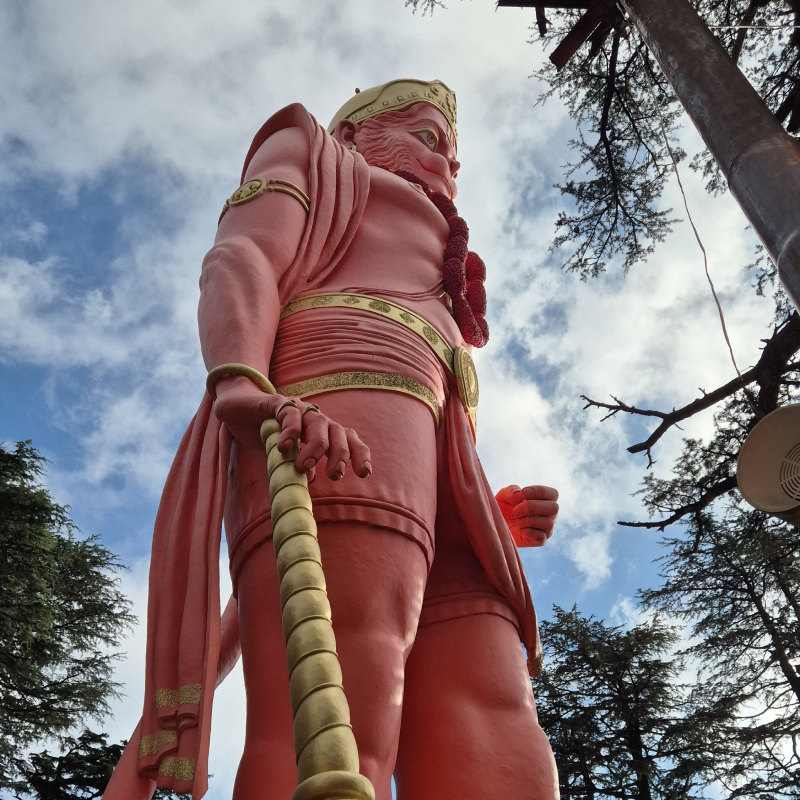
Table of Contents
Jakhu Temple Location & How to Reach Shimla
Location: The Jakhu Temple is located on Jakhu hill, approximately 2-3km east of the town center of Shimla (The Ridge/Mall Road area). The temple is approximately 2.5km east of the Ridge and at a height of approximately 2,455m according to the official sources. It is the peak of Shimla commonly referred to as the highest point of Shimla. To map, all you need to do is to enter the following in Google Maps: Jakhu Temple, Shimla and it will lead you through the zigzag hill road to the temple premises.
Access to Shimla: Shimla is accessible to major cities. The closest airport is Jubbarhatti (2025km away Shimla). When using a train, one rides a Kalka-Shimla narrow-gauge train or any other train to Kalka and then the heritage toy train or road ride to Shimla. Shimla is accessible by road via Chandigarh/Delhi highway and can be accessed by personal car or normal bus. After arriving in the city of Shimla, the jumping-off point of most visitors is the Ridge/Mall Road.
Jakhu Temple is accessible on foot, car or taxi or the new ropeway (see below) from central Shimla. The Temple road is a winding road that starts at the vicinity of The Ridge; it is approximately a 2km climb. Most of them prefer walking the forest path (approximately 30-45 minutes uphill), and some people use a taxi or a ropeway.
The Ridge and Mall Road are the primary shopping streets and public square of Shimla, both of which are a few kilometers away, which means that even a vigorous walk or a pony ride is possible. The Ridge has shared local taxis (jeeps), which provide a cheap ride up the mountain (around ₹50100 per person one-way in 2025 prices). There are also taxis between Shimla and Jakhu, however, they are more expensive per vehicle.
History and Legends of Jakhu Temple
Mythological Foundations: The hill (Jakhu) and temple are dipped in the Ramayana epic. It is believed that Lord Hanuman halted here in his search of the Sanjeevani herb to heal Lakshmana. He encountered the sage Yakru on the hill-top and vowed to come back after the war. But Hanuman was detained in the combat against the demon Kalnemi, and could not meet Yakru at once. When Hanuman eventually returned after the battle an idol of him had appeared miraculously on the hill.
In order to worship Hanuman, this idol was surrounded by the Jakhu Temple constructed by the sage Yakru. The same place where Hanuman is claimed to have landed his foot is now a part of the shrine.
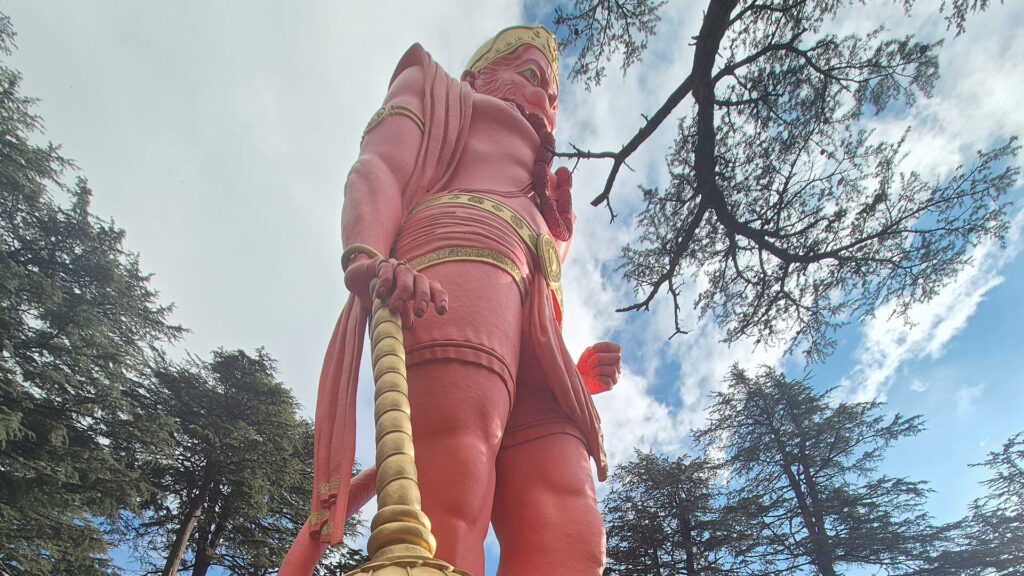
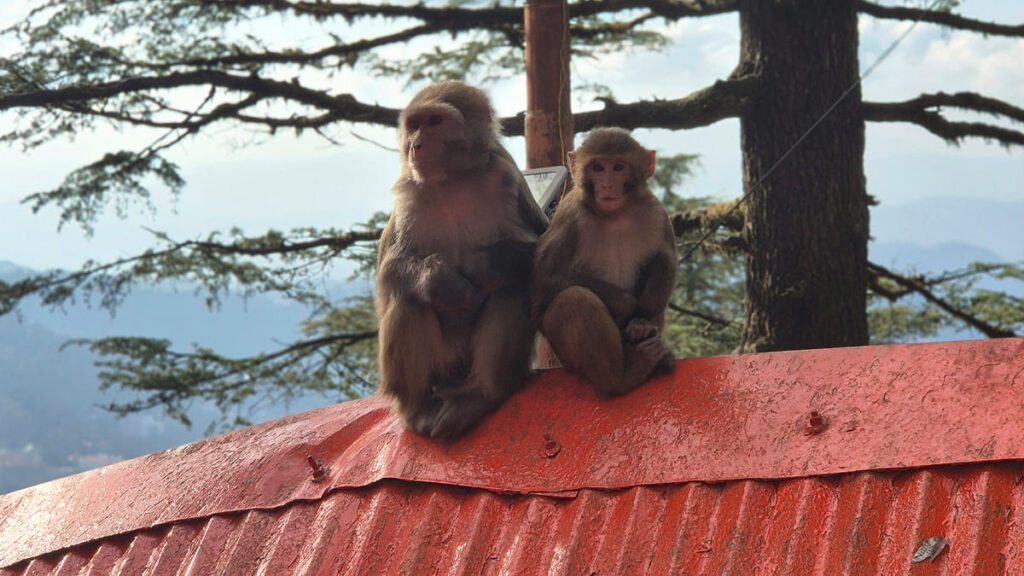
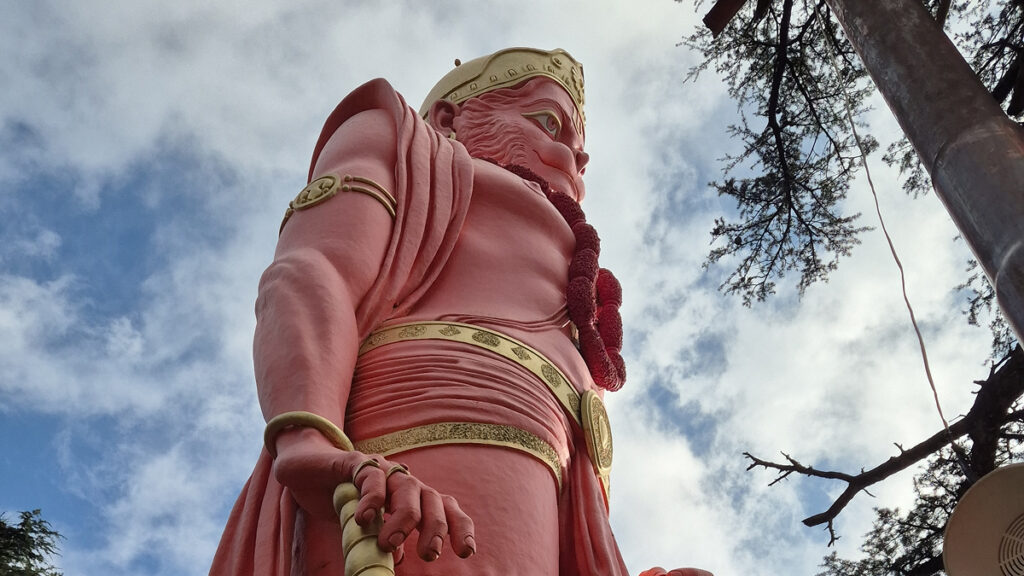
Local folklore still exists: the numerous monkeys inhabiting the temple are said to be the descendants of the army of Hanuman. Devotees have contributed to the shrine over the centuries. The existing historic temple building is several centuries old, but it has been renovated and enlarged. Here in 2010 a giant 108-foot statue of Hanuman was unveiled, which is now one of the tallest Hanuman statues in the world. (read the history)
Jakhu Temple’s Height and Mountain Views
Jakhu Temple is the highest point in Shimla, which is approximately 2,455 m (8,048 ft) above sea level. (Some sources round this to ~2,438 m.) The temple platform gives a view of the whole valley of Shimla and the surrounding ranges. The forested hills drop to the view of the expansive town of Sanjauli and the acres of Deodar and oak forest. On sunny days one can see the snow-covered Himalayan mountains to the north and west.
Getting to Jakhu Temple: Ropeway, Taxi, and Trekking Options
There are three main ways up Jakhu Hill: by ropeway, by road (taxi/cab), or on foot. Each has its perks.
By Ropeway: Scenic Cable Car Ride and Ticket Prices
A ropeway (aerial cable car) has been operating in Shimla since 2017, between the area of The Ridge and the temple. The ride lasts only about 68 minutes and flies above the trees, giving you spectacular aerial views as you ascend to the 8,100 ft level of the temple. The ropeway runs every day between approximately 9:30 AM and sunset (when it is snowy, it closes earlier), which is handy during winter when roads can be snow-blocked.
The prices of the tickets are quite affordable (2025 rates): a round-trip costs around 470 per adult, 400 per child (3-12 years). Single-way tickets are approximately half the price ( 250 adult, 200 child). (Children below 3 usually ride free) The tickets are sold at the venue or through the internet. The gondolas have a capacity of 6 each and the station has snack and washroom facilities. The Ridge in town is just 500 m away from the ropeway base, meaning that you can even walk to the station.
By Road and Taxi: Route, Fare, and Local Tips
The more conventional way is to drive or take a cab to the base of the temple. The temple road begins at the vicinity of the Ridge/Mall Road and ascends to the Jakhu Hill in a distance of 2-3km. The meandering road provides some clearings where you can take some photographs.
- Taxis/Jeep: Hacked jeep taxis (commonly referred to as HRTC shuttles) regularly leave The Ridge to Jakhu Temple. These common cabs are very inexpensive – about 50-100 per head one way in 2025 (exact prices differ) – and leave you at the upper parking lot. One can also hire private taxis or Suzuki Gypsies and be delivered to the door; the cost might be a few hundred rupees. It should be noted that mountain roads and narrow lanes are steep, and thus bigger vehicles might not reach the top.
- Walking: You can even walk to Jakhu Temple, though, if you like, you can walk along the Ridge. The increase is approximately 2km of uphill climbing on a rugged yet well-kept trail, and usually takes 30-45 minutes. The wood walk is smooth and shaded, with pine and oak. It is a favorite tourist and local hiking path (the ground is soft and it is clearly marked). On the road you can see a little police check-post and a few shops where walking sticks are rented. It should be noted that the trail has dozens of monkeys (see below), so maintain a safe distance and fasten any loose objects.
Trekking Jakhu Hill: Himalayan Nature Park Trail
To be more adventurous, you may hike in the nearby state forest and Islamabad Sanctuary (also referred to as a section of the Himalayan Nature Park in the area of Kufri). Since the beginning of the Jakhu road, there is a distinct forest walk uphill through fir, cedar and oak trees. The total increase can be 1-2 hours between the Ridge and the peak, depending on the speed. On the road, look out to Himalayan animals such as spotted deer or pheasants. The pathway then joins the road towards the entrance of the temple.
It is a hike with cool mountain air and scenery that improves with every step. On the route there are a few local stores that rent wooden sticks (₹1020) to assist hikers. To be safe and comfortable: wear strong shoes, carry water, and be in the daytime. (During winter the path may be icy, so trekking poles and winter boots are a good idea.) When you arrive at the temple, you are left with 300 stone steps to go before you enter the sanctum – an appropriate end to the hike!
Jakhu Mandir Timings, Entry Fee & Daily Rituals
The Jakhu Temple is available all day long since early morning up to evening. Darshan timings, according to the official sources, are 7:00 AM to 8:00 PM every day. During festival days these hours can be stretched a little, but as a rule the gates of the temples are closed about 8 PM.
No entrance fee or ticket fee. Visitors and all worshippers are free to enter. Donations to the upkeep of temples are, however, welcome. Pilgrims are advised to take off their shoes prior to entering the sanctum as it is customary. The temple operates a community langar (free vegetarian meal) to the devotees on special days such as Tuesdays, Sundays and festival days.
Traditional Hindu aarti ceremonies are part of daily rituals. Although certain aarti times may differ, typically three aartis are performed: early morning (Mangala), noon (Bhoga), and evening before closing (Shayana) as is the case in Hanuman temples. These prayers are usually attended or followed by visitors. Special decorations are also made on the shrine especially during Hanuman Jayanti (spring) and the Dasara festival in autumn.
Monkey Etiquette: Staying Safe with Shimla’s Langur Monkeys
- Guard your stuff. Store valuables (food, water bottles, cameras) safe. Keep loose things such as spectacles or snacks in your bag. Monkeys find it easy to pick and steal loose items.
- Wear or hold shoes. You must take off your shoes at the entrance of the temple, but carry a bag or a hanger to keep them safe. When shoes are not properly taken care of, monkeys tend to pull them.
- Avoid direct eye contact. Do not stare aggressively. Eye contact may be regarded as a challenge in monkey language. Remain composed when one comes near- move away gradually without screaming.
- Maintain distance. Look but don’t touch. Monkeys are wild, despite being accustomed to people. Do not attempt to feed them by hand, or to tease them, even in jest.
- Use a deterrent if needed. Others bring umbrellas or sticks (which can be rented at the temple gates) to shield themselves or scare away monkeys in case one is too inquisitive. Monkeys tend to respect their home territory, and therefore, it is best to remain calm and non-confrontational.
These few tips will ensure that you can have a good time at the temple. The monkeys are certainly guardians of Jakhu, but a glance at your baggage makes the visit amiable to all.
Jakhu Mandir Map (Location & Route Guide)
To get there, enter Jakhu Hanuman Temple, Shimla, in Google Maps. It will depict the precise path to the top of Jakhu hill starting at the centre of Shimla. Geographically, it is approximately 31.101 o N and 77.182 o E. The temple is well marked on the map on the top of Jakhu hill. There are generally route choices of driving (shortest road of The Ridge), hiking (scenic road), or the ropeway station (aerial road to the temple). The Mall Road of Shimla has a Google Maps or any other GPS application that will easily lead you to the temple door.
Top Places to Visit in Shimla: Attractions Around Jakhu Temple
There are a number of attractions that surround the Jakhu Hill area that make Shimla a good travel destination:
- Himalayan Nature Park (Kufri Wildlife and Nature Trails): The Himalayan Nature Park (also known as Kufri Zoo) is a 90-hectare wildlife sanctuary located at an altitude of approximately 2,600m, about 1718km east of Jakhu hill. It has Himalayan vegetation (oak, fir, deodar) and cages with snow leopards, musk deer, Himalayan bears, Tibetan wolves, pheasants and other indigenous animals. These animals (often in almost natural settings) and forest views can be seen by taking a stroll through its winding trails. The park has guided trails and viewing hides that are enjoyed by families and nature lovers. The park is opened at approximately 9 AM and closed at 5 PM. Although it is not directly neighboring Jakhu Hill, it is usually combined during excursions as it is located on the route to Kufri.
- The Ridge and Mall Road (Historic Heart of Shimla): The Ridge is a wide central walk and cultural centre (at approximately 2,206 m elevation) directly above Mall Road. It is surrounded by colonial era structures (including the renowned Christ Church) and has a panoramic view of the mall and the hilltop. The nearby Mall Road (1 km long pedestrian shopping street) is a busy bazaar, where there are shops, cafes, and food stalls. Here you will be able to shop Himachali handicrafts, woollens, local delicacies and appreciate the architecture of the British era. The Ridge and Mall Road are ideal to take an evening walk, enjoy the sunset behind the hills, and taste the local snacks or tea. The towering statue of Hanuman on Jakhu Hill to the east can also be seen well at The Ridge as a reminder that Jakhu Temple is just a short drive or walk away.
- Tara Devi Temple and Other Hilltop Shrines: Tara Devi Temple is another prominent hill shrine, which is situated approximately 11 km north of Shimla on Tara hill. This temple of goddess Tara is located at an altitude of about 7,200 ft (2,195 m) and is visited by the devotees because of its beautiful idol and scenery. The pilgrimage to Tara Devi is more serene as it is done by walking through meadows and forests. There are also other historic temples in downtown Shimla: one of them, the Kali Bari Temple (devoted to goddess Kali), is located close to Mall Road. Kali Bari was built in 1845 and is the oldest Hindu temple in Shimla. These hilltop temples add to the mountain mystique of Jakhu, and are frequently part of local sightseeing tours.
- Kalka Shimla Heritage Toy Train (Mountain Railway): To have a memorable ride to or from Shimla the Kalka Shimla Toy Train is a must. This is a 96 km narrow-gauge mountain railway (constructed in 1903) which is a UNESCO World Heritage site. The train runs on a picturesque route that has 107 tunnels and 900+ curves, starting at Kalka (656 3 m) and reaching Shimla (2,075 3 m). On its route it has 17 stops (such as Taradevi and Barog) where you can take a break and have some refreshments. The ride provides unmatched sceneries of terraced fields, pine forests, and steep valleys. The choices include the quaint Shivalik Deluxe Express (luxury air-conditioned coaches) up to the classic Himalayan Queen train. The Toy Train ride is one of the best experiences that many travelers have to offer, as it offers a front-row view of the natural beauty of the region.
Photography and Viewpoints: Capturing Panoramic Views from Jakhu
Jakhu Temple is the dream of a photographer. The vantage point on the hilltop forms 360 degree perspectives: the Hanuman statue in the foreground, the treetops in the background, and the mountains stretching indefinitely on the horizon. The main photo points are: the platform in front of the shrine (to take city and statue shots), the upper deck of the ropeway station (looking down into Shimla), and other clearings on the road leading to the temple.
Best Time to Visit Jakhu Temple: Seasonal Travel Guide
Tourists come to Shimla all year round, but there are some seasons when it is best to visit Jakhu Temple. The local guides say that the best weather is during spring and early summer (March-June). The weather in these months is 1520 o C, the skies are clear and the forests on the hills are green. The mornings are cool and the daylight is long, and so the trekking and sightseeing are comfortable. Visiting at that time will mean sunny days with little rainfall, which will be ideal to have panoramic views of Jakhu.
Autumn (September-October) may also be a good time: the monsoon is over, the air is clear and the Dussehra festival and local fairs provide cultural color.
Shimla is cold (usually below zero at the altitude of Jakhu) and often snowy in winter (November-February): Assuming you like snow, this is when you can see Jakhu Temple covered with white. Wear a lot of clothes and look at the road conditions – the heavy snow can sometimes close the road, but the ropeway can still operate on cleared days. Moreover, winter fog may hamper visibility and thus mornings are usually better than afternoons.
The heavy rains and clouds occur during monsoon (July-August): Trail tracks and roads may get muddy or greasy and visibility is low. The monsoon season is not usually recommended, except when you have rain gear and are simply in the mood to have the green monsoon atmosphere (Chadwick Falls, nearby woods etc.). During the non-summer seasons, a light raincoat or umbrella is always essential.
Overall: visit Jakuhu in April-June or October-November when the weather is good and the view is good. The best light is at early morning or late afternoon. And when you go in winter wrap up and go there about noon, when it is warmest.
Practical Tips for Families, Pilgrims, and Nature Lovers
- Bring necessities: Water, sunblock, and sunglasses (the sun is fierce in the mountains). Snacks come in handy – but keep them closed (monkeys will smell them!). In case of trekking, put on strong shoes. The hilltop may be cold even in summer, so carry a light jacket.
- Wear simple clothes: This is a sacred place, and conservative clothes are welcome (particularly among women). Take off your shoes in front of the shrine.
- Book ropeway tickets: The ropeway may be congested during holidays/peak season (summer holidays, Dussehra). Make reservations in advance, where possible.
- Time of the day: Weekdays are not so busy. Mornings or late afternoons are not in the heat of the day and they provide you with the best light. Remember that the final ropeway leaves 30-60 minutes before closing.
- Observing the monkeys: (Already discussed above) Store food away and lock up belongings. Even children are to be warned.
- Fitness Climbing: It is an uphill climb. Make rest stops on the ascending way, particularly when carrying old folks or children. There is no hurry to the last 300 steps, be slow.
- Facilities: Toilets and a small cafeteria are located close to the temple that serves vegetarian food and chai. It’s a good spot to rest.
- Respect the temple: It might not be allowed to take photos in the sanctum. Note silence or low tones around the prayer hall. Participate or observe the aartis with due respect should you like.
- Sightseeing: Jakhu Temple can be included in a day of sightseeing with other Shimla attractions (e.g., Ridge/Mall, Christ Church, Viceregal Lodge, Kufri Wildlife Park). Make your path in a way that will reduce backtracking.
With such considerations, families will have a safe adventure (strollers are not a good idea on the trail, so carry carriers with young children), pilgrims will have a spiritual time, and nature enthusiasts will enjoy the Himalayan plants and animals on the path.
My Personal Experience Visiting Jakhu Temple
This was a special visit to Jakhu Temple. I have been to the temple numerous times previously, even with tourists, but this time I went with my friends on our bikes and the entire experience was of a different nature of fun. We started early in the morning at Chandigarh and used the New Bus Stand road since the main road is normally very busy. This path is easier, less noisy and the bike nearly reaches the top now.
As we arrived on the top side of the hill, we could view the new escalator. It was just 20 rupees per person (at the time of November 2025). It simplifies the climb particularly when you are fatigued. One can always take the stairs, should he or she wish. However, we were on a bike tour and we conserved our energy and took the escalator.
One thing to watch out about: monkeys. I always remind people to carry their prasad, sunglasses and small things in their pocket or bag. The monkeys at Jakhu are fast–they can seize things in a second. We put it all in safe keeping, then walked up.
The temple is only a short walk after the ride on the escalator. The biggest thing that strikes your eye is the giant 108-ft statue of Hanuman. I always feel amazing no matter how many times I watch it. At about 2 PM, we arrived and the weather was ideal. The entire panorama of Shimla was visible and gorgeous.
The temple grounds are clean and cozy. It has clean washrooms, seating areas and the Kangar Bhawan langar where they offer simple veg food. It shuts down early, at about 3 PM, and thus we were in time to eat. Then we proceeded to the small garden and captured some pictures with the statue.
The calmness, the fresh air and the ringing of the temple bells made the entire experience very relaxing. We sat and prayed a little, enjoyed the scenery and then began riding back to Chandigarh.
I have the same combination of peace and happiness every time I visit Jakhu Temple. However, this time I went out on a bike with my friends, which made the experience even more memorable.
Jakhu Temple FAQs
What are the opening hours and charges of Jakhu Temple?
The temple is available every day between 7:00 AM and 8:00 PM. No entry fee is charged and it is free to all visitors. (Gifts and contributions are not compulsory.)
What is the height of Jakhu Temple and statue?
The peak of Jakhu Hill is approximately 2,450 m above the sea level (approximately 8,050 ft). The statue of Hanuman itself is 108ft high.
How do I reach Jakhu Temple?
The ropeway can be taken at the Ridge in Shimla (5-8 minute ride), a taxi can be hired or one can walk up (30-45 minutes). There are cabs and jeeps around Mall Road/The Ridge. The least expensive is shared taxis. Every path leads to the temple parking lot, and then it is a short walk or steps to the shrine.
How much are the ropeway tickets?
By 2025, round trip ropeway tickets will be approximately 470 INR per adult and 400 INR per child. (One-way is half that price.) Children below 3 are normally free riders.
Are monkeys dangerous?
Jakhu Temple has a large number of langur monkeys, which are not violent when left alone. They will steal food or things left unattended, and therefore observe monkey-safety measures (keep away, lock up). Do not attempt to feed or touch them. Families and elders do not normally have any problem with caution.
Conclusion: Embracing the Spirit of Jakhu Temple
Jakhu Temple is not merely a shrine, it is a representation of the spiritual and natural beauty of Shimla. It is situated on the clouds and provides the visitors with an opportunity to forget about the life of the town and experience the grandeur of the Himalayas everywhere. Ancient myth (the legend of Hanuman), living culture (monkey guardians, temple rituals) and wild beauty are what make Jakhu Temple so unique and fascinating.
Jakhu is a blessing to a devotee, a photographer in search of picturesque views, and a family in search of Himalayan adventure. It is a place where each sunrise is sacred and each look is surrounded by pine forests and mountains. According to one of the local guides, this is a hilltop Hanuman temple that is a must-visit to anyone in Shimla. A tour here will make you feel awed by the magnificence of nature and a feeling of peaceful piety – the very soul of the beloved Jakhu Temple of Shimla.


It’s awesome! Hanuman’s cool story, the huge 108-foot statue, and those fresh pine paths make it feel like a peaceful hike with killer mountain views. Take the cable car up, watch the monkeys play—great side trip in Shimla. Love it for chill vibes or fun adventures!
Thank you, Rajesh! 🙏
I’m really happy you enjoyed Jakhu Temple, the 108-ft Hanuman statue, and the pine forest trail. The ropeway is a great option, and yes—keeping an eye on your belongings around the monkeys is important. Thanks for sharing your experience in Shimla!